Table of Contents

Community Eye Health Services

Ispahani Islamia Eye Institute & Hospital (IIEI&H) is a legendary Ophthalmic ‘Not for Profit’ Hospital and Institute in Bangladesh, which was born in 1960 with a mandate not only to provide quality eye-care for all segments of society but also train doctors, surgeons and paramedics to serve the country. IIEI&H has set up an effective amazing network of eye health services through a chain of Hospitals (1 Tertiary Level Eye Hospital in Dhaka, 3 Secondary Level Eye Hospitals at Barisal, Naogoan and Jamalpur, 1 Branch Hospital at Kulaura and 17 Primary Level Eye Centers – known as Vision Center located at rural areas). Currently IIEI&H Dhaka Hospital is respected as the best Tertiary / Referral Eye Hospital in the country.

In order to provide support to the rural unserved and underserved ophthalmic patients, IIEI&H has set up Community Eye Health Services. Presently, a team of nearly more than 250 devoted staff members including Ophthalmologists, Doctors, Optom, Refractionist, Outreach teams, Nurses, MLOPs and other support staff along with a small management team have been reaching out the people in need of services at various remote communities and making the quality eye care accessible and affordable to people along with a stringent provision of safety-net for poor people with the slogan “No Refusal of Eye Care Services Due to Money”.
Over the years of community eye health services, they were able to directly impact the lives of millions of people and their families, who otherwise would have been unidentified victims of visual impairment. The recent expansion of their Primary Level Eye Care Centers (LPECC) run with the support of tele-consultation and tele-ophthalmology, which have enabled them to take the Ophthalmology to the people’s doorsteps for providing uninterrupted quality eye care services more accessible for remote rural community people even in the global pandemic of Covid-19.
Accompanied by dynamic governance, empowered & brilliant teams, modern technology and the right people at the right place along with the mechanism of continuous need-based learning opportunity and appropriate home-grown capacity building initiatives, they have evolved into a robust community eye care service delivery mechanism at IIEI&H.
Despite of the recent global pandemic of Covid- 19, their Community Eye Health Services have provided the following services from its various Services Delivery Points of all 3 Secondary Level Eye Hospitals, 1 Branch Hospital and 17 Primary Level Eye Centers in 2020-21:

Community Eye Health Services was launched in 2008 at Jamalpur through setting up a Branch Hospital there. The second one was at Barishal in 2010 and the 3rd one at Naogaon in 2011. The current model of the PLECCs have been piloted in 2016 at Atrai Upazila under Naogaon SLEHs. Since then, they have set up a total of 17 PLECCs in various remote Communities under those 3 SLEHs of IIEI&H located at Barisal, Jamalpur and Naogoan. In January 2020, a PECC+ was set up at Kulaura and that has later been upgraded to a Branch Hospital.
Similarly, following are the Cataract Surgeries conducted under the Community Eye Health Services in the year 2018-2019, which is presented against the SDPs of all 3 Branch Hospitals:

The following table has the summary of the services provided in year 2020-21. The services are presented against the corresponding Branch Hospitals, which includes the services from other SDPs (CECs, CEPs and Outreach Camps) under the respective Branch Hospitals.

Outreach Programs:

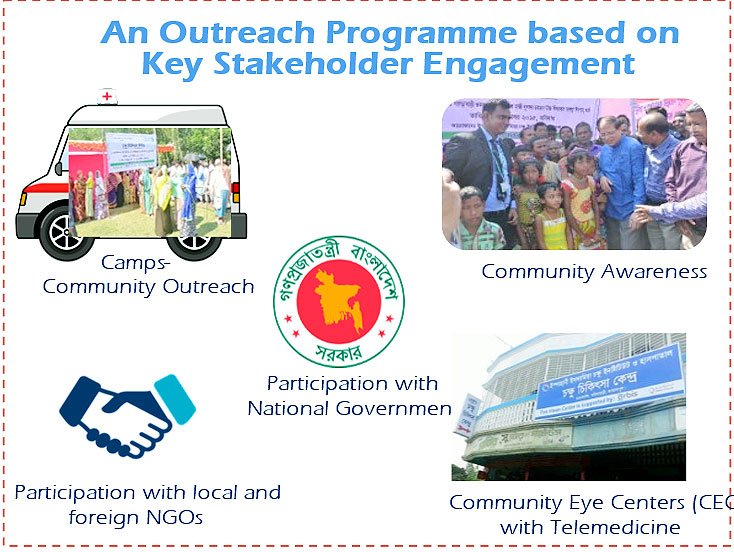
Outreach programs are the key mechanism to reach the unreached and underserved as their mobilities are mostly restricted due age, religious reasons, lack of decision-making ability, accompanying person, financial dependency and lack of information to some extent. The outreach programs can successfully address most of those. Therefore, this remains as a better choice to reach them for services. In all three Secondary level Eye Hospitals, we have skilled outreach teams consists of trained Doctors, Optometrists, Refractionists, Ophthalmic Technicians, Optics Fitting Personnel, Support Services Personnel and the Camp Organizer for conducting comprehensive eye camps at remote rural communities to serve the patients and to mobilize patients for surgeries. During the reporting period, 90,874 patients were served from 1,037 Cataract Screening Camps, SSTP, Refraction Camps, and other Sites.

The camp teams have their equipped vehicle for Outreach. The team takes care of both way transportation of the surgery patients – to and from the hospitals to their respective community. The Camp Organizers have their monthly camp plans, which is monitored by weekly web-based camp performance review and follow-up monitoring meeting with the carefully facilitation of Director, Community Services on regular basis. Community outreach programs are run with the concept of ‘Relationship Driven Community Awareness,’ approach, where the community people are fully engaged as partner of the camps and our camp organizer works as the facilitator and where our team provides quality eye care services. A total 41 Community Vision Committees (CVC) are formed in our working areas to support the community outreach programmers. This initiative is supported by continuous hands-on training at the respective communities aided by instantaneous trouble shootings, cross-learning and exposure visits, local level advocacy and various innovative initiatives i.e., SSTP, workplace & waiting mothers’ meeting. In this reporting year, a total of 12,118 stakeholders were reached through 569 Advocacy Programmed in the community.

Primary Eye Care Centers (PECC) & Community Eye Care Points (CECP):

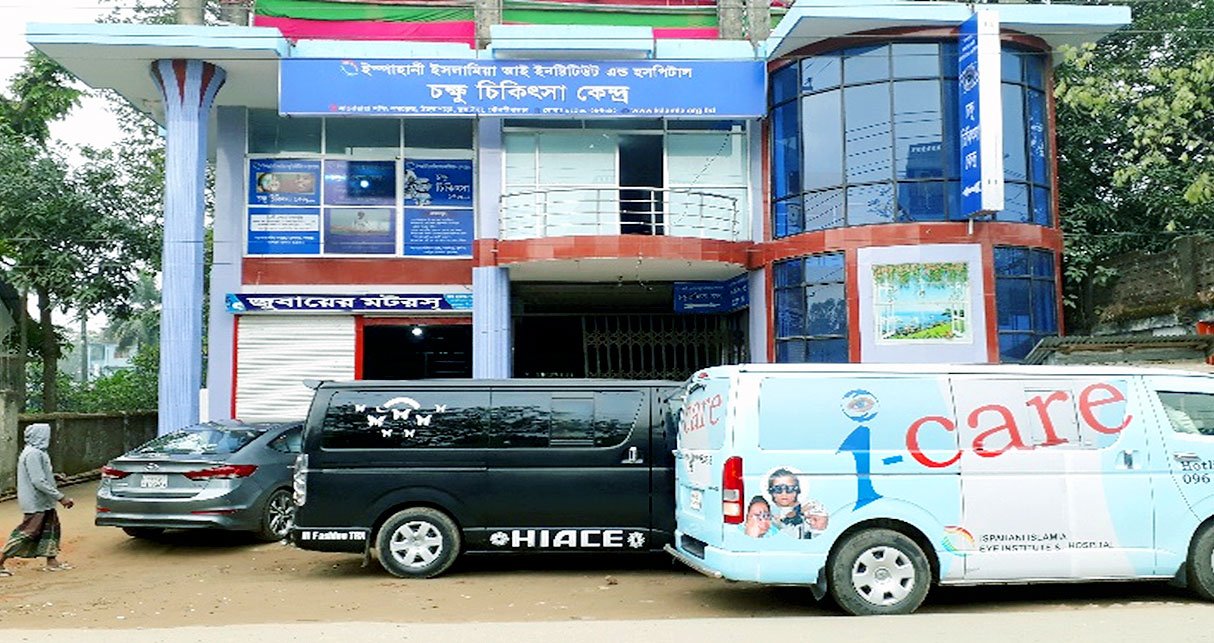
In the recent years, Ispahani Islamia Eye Institute and Hospital have launched 17 Primary Level Eye Care Centers (PLECC) and 31 Community Eye Care Points (CECP) under 3 Secondary Level Eye Hospitals situated in Barisal, Jamalpur & Naogaon Districts. These Centers are located at very remote rural areas, where hardly people have met any Ophthalmologist or Doctor in their lifetime. The Centers usually run by Optometrist with every treatment advice through virtual supports of the Doctors of the respective Branch Hospitals. The PLECCs mainly work for 3Rs – Recognition (initial Recognition of eye diseases/ problems and small procedures including stich removal/ follow of surgery patients and process facilitation), Refraction (Precise Refraction)

and Referral (Referral of Surgery patients to Branch Hospitals and complicated patients to Dhaka Hospital through respective SLEHs). All the Doctors and staff of IIEI&H are very dedicated and give utmost priority to each of the patients. The management oversee the implementation with utmost priority – fortnightly all the CEC teams has scheduled cyber meetings for progress review and planning for the following weeks.

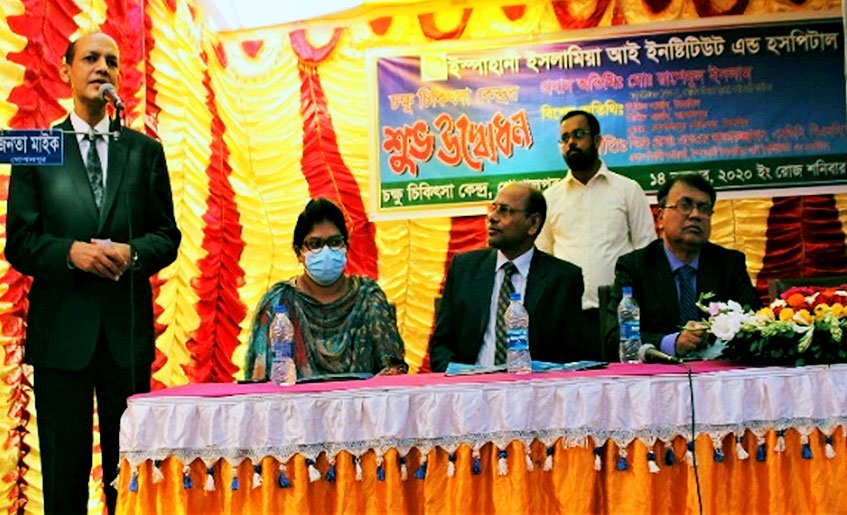
In 2020, 3 new PLECCs (vision center) and 1 PLECC + were inaugurated. PLECC Rangabali, PLECC Lalmohon and PLCC Gopalpur are located at Patuakhali, Bhola and Tangail district, respectively. PLECC+ is established at Kulaura under Moulavibazar district. This has been upgraded as a Branch Hospital, which is equipped with surgical facilities.

At the PLECCs, the surgical conversion rate is around 75%, while the spectacle conversion rates are over 80%. The PLECCs are contributing to the growth and sustainability of respective Secondary Level Eye Hospitals, while CECPs (Vision Points) contribute to the sustainability of the PLECCs. 70% of the PLECCs are sustainable both programmatically & financially.

Landmark Initiatives towards Institutional Sustainability:

Most visually impaired people throughout developing world are suffering from preventable visual impairment. IIEI&H has already taken various initiative in last decade and all of them are almost self-sustained. In order to further strengthening those and giving long lasting shape, the management of IIEI&H has decided to have its own campus specially in those Secondary Level Eye Hospital and Branch Hospital. Recently, the management of IIEI&H has purchased THREE lands to build its own campus for three Hospitals at very strategic locations at Kulaura, Naogaon and Barisal, respectively.

The management has also started construction there to build respective boundaries and taken initiatives to produce its generic building model eye hospital for its community services. Followings are some pictures of the lands, and its construction works there:

The newly purchased land is located next to the existing hospital building of Barisal (adjoining land), and there is a small structure (old but workable building) on the land as well. Therefore, the management has decided to use that existing structure to introduce patients with our own campus for enhancing patients’ satisfaction, security system and utilization of existing resources. The following picture with our branding of IIEI&H community services depicts the use of the newly purchased land along with the existing hospital building on rental structure.

With the hard works of the community services management team, the kind guidance of the respectable CEO and the generous support of honorable members of the MC (Management Committee), have been serving patients and assisting them to go back to their regular work and bringing back the SMILEs of several thousand disadvantageous people in each year in the unreached and unserved remote rural communities of the country. With the brilliant plan for institutional sustainability of building its own designed branded generic community eye hospital at its own land will accelerate the reach of the unreached with quality eye care services of global standards.

Regular Supervision and Monitoring of Community Services:

The management team takes it regular supervisory and monitoring visits at remote locations to tertiary level Eye Hospital – Community Eye Points, PLECCs, SLEHs and Tertiary Level Eye Hospital. The following images depict those:

Scroll to Top